


Modern Day Battlefield is evolving:
Missiles are being replaced by Loitering Munitions
Fighter aircraft are making way for unmanned combat drones
Tanks and heavy infantry vehicles are being replaced by more nimble unmanned ground vehicles with autonomous weaponry
These changes are forcing strategists to reboot the offensive and defensive strategies. Especially in Aerial conflicts, the UAV technology is growing leaps and bounds, the defensive side is slow to catch up, creating lots of asymmetric outcomes - If you have to shoot a $30K drone with a million dollar missile, do the math, it’s game over!!
Recent conflicts, such as the Russian-Ukrainian Conflict, Operation Sindoor, and the ongoing conflict in the Middle East, have shown the need for well-established Air Defence (AD) Systems.
Opportunity lies in the solution of this asymmetry!
When the offensive is led by low-cost UAVs and loitering munitions that can neutralize multi-million dollar assets and can saturate air defences, the solution also needs to be a low-cost alternative, especially with less incremental costs to defend. The current AD systems are prone to economic attrition as stockpiles deplete faster than can be replenished by industrial bases.
The traditional kinetic doctrine—relying on physical projectiles—faces three Challenges:
Limited Magazine: You can only carry so many missiles.
Logistical Tail: Transporting heavy ammunition is slow and vulnerable.
Collateral Risk: What goes up must come down, often with explosive consequences in urban areas.
One of the solutions to this asymmetry is Directed Energy Weapons (DEWs):
Near-Zero Cost-per-Shot: Firing a laser for several seconds costs roughly the price of a few liters of fuel.
Infinite Magazine: As long as there is power (via a generator or battery), the weapon can keep firing.
Surgical Precision: They can disable a drone’s camera or melt its motor without destroying the entire surrounding area.
Note: The technology is still in developmental stages. Most deployed or near‑deployed systems are still in the low-medium power range and aimed at small, vulnerable targets. Directed Energy Weapons (DEWs) - The Great Leveler
DEWs use concentrated beams of light or radio waves to damage or disable a target.
At its core, a directed energy weapon swaps out explosive material for electricity.
Broadly, there are two types:
(1) High-Energy Lasers (HEL) and (2) High-Power Microwaves (HPM)
They deliver speed-of-light engagement, near-zero per-shot cost, and effectively unlimited magazines. Adoption is accelerating as drone swarms, missile salvos, and hypersonic threats strain traditional interceptors.
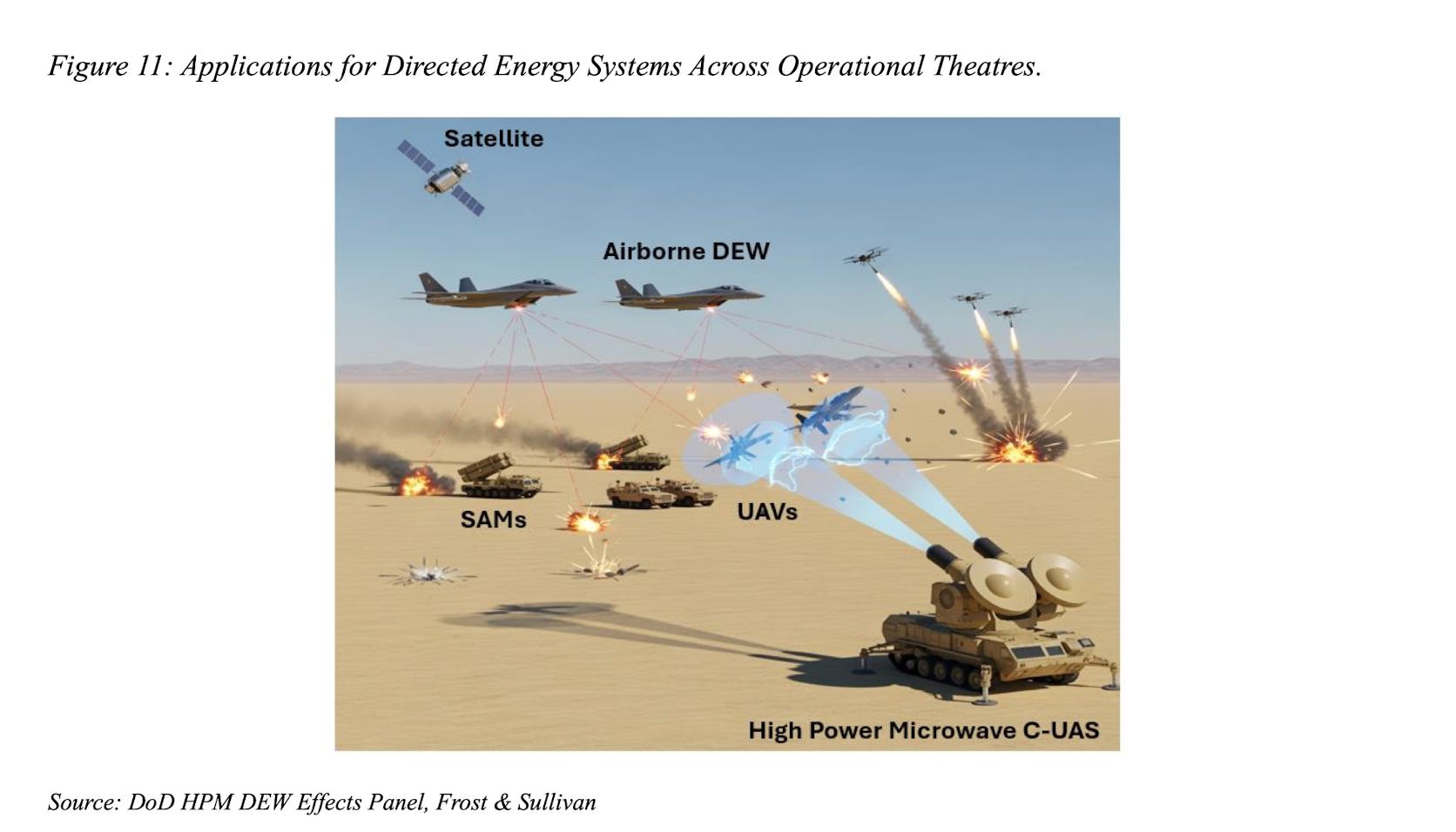
High Power Microwave (HPM) systems provide a non-kinetic alternative by projecting directed electromagnetic energy to disrupt or disable drone electronics at tactically useful ranges. HPM offers scalable effects—from temporary disruption to permanent damage enables simultaneous engagement of multiple targets, and delivers a very low cost-per-engagement compared with missiles or guns. These attributes reduce logistics burdens and allow sustained defensive operations against massed autonomous threats.
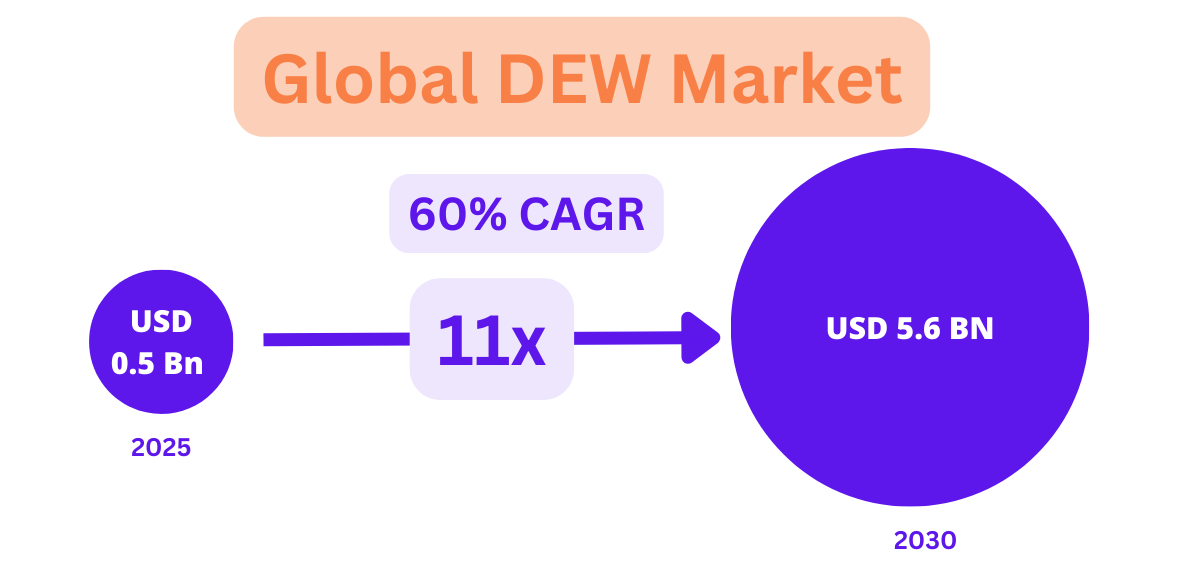
In more clearer terms
Laser based systems need precise pointing and tackle one drone at a time
High Power Microwave (HPM) systems can neutralize a swarm of drones
Indian Context
For India, the directed energy weapon space is still early but no longer theoretical. There is a growing government interest, especially for air defence, anti‑drone and border security roles.
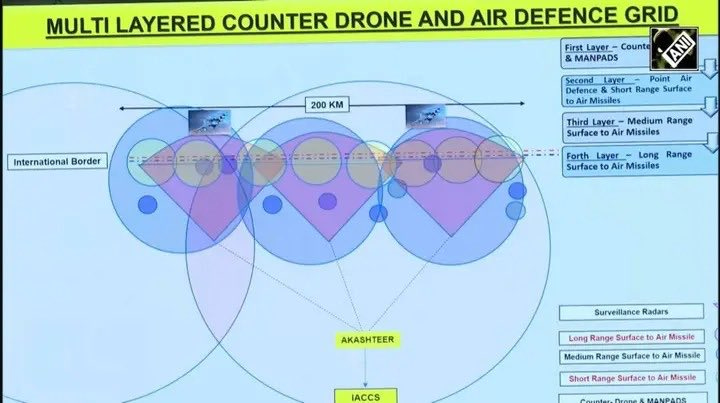
Directed Energy Weapons will be integral in the Akashteer AD system especially against the swarm of drones/vectors that can saturate the AD.
1) Sahastra Shakti
Following the successful trials of the Mk-II(A) Sahastra Shakti 30kW laser system in April 2025, India has joined an exclusive club of nations (US, Russia, China, Israel) with operational DEW capabilities.

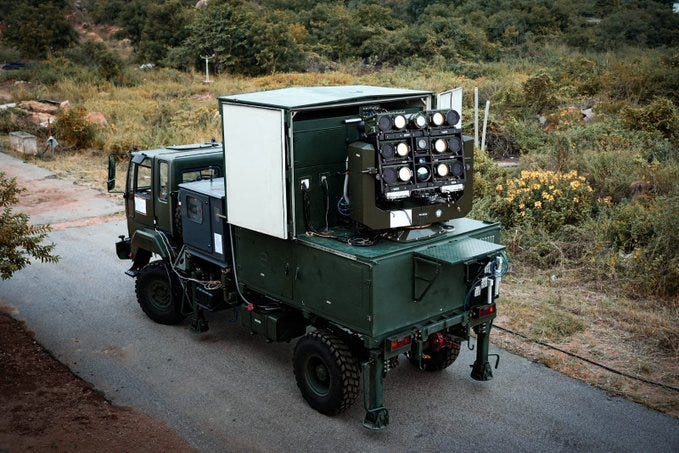
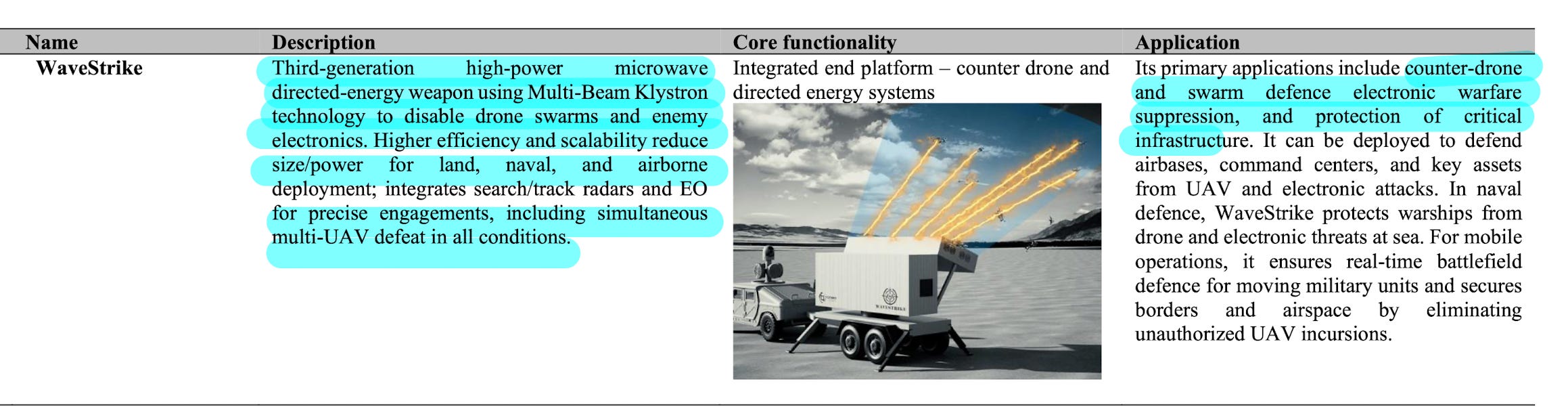
2) Tonbo Imaging - Wavestrike
High-Power Microwave (HPM) system designed to neutralize drone swarms and disrupt electronic infrastructure - Multi-Beam Klystron (MBK) technology.
Compact footprint for versatile deployment across land, naval, and airborne platforms.
3) Apollo Microsystems
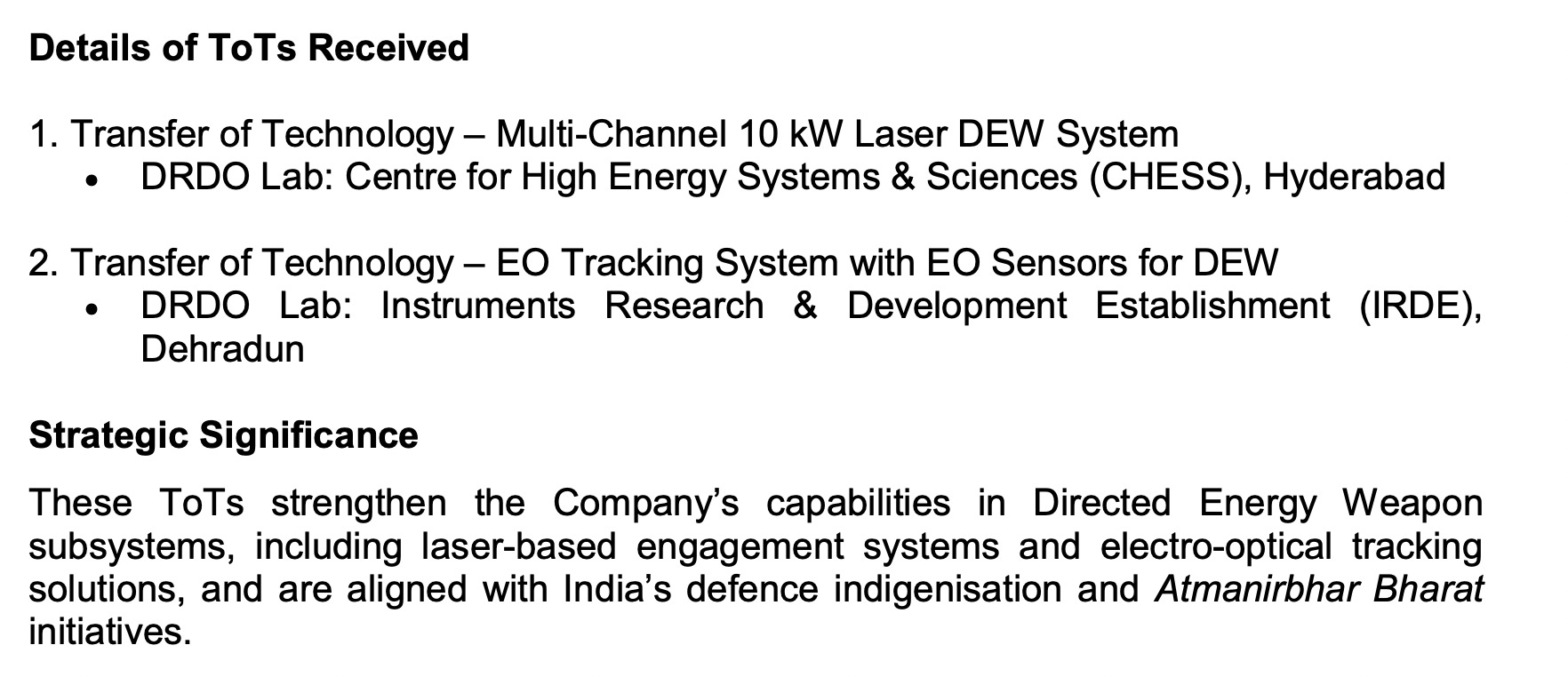
Received Technology from DRDO for 10 KW DEW
To Conclude
This is a fast-growing and much-needed segment in Air Defense.
On the one hand, the physics is proven, key components exist, and early systems are being tested. However, the development challenges still exist to put these systems at scale.
There is a visible technology curve, a clear problem to solve (cheap drones, missile saturation, munitions costs), but a deployment path that will likely be lumpy and programme‑driven rather than smooth.
There will be opportunities, especially in the underlying picks‑and‑shovels – optics, power electronics, sensors, integration – when these DEWs will be deployed at scale.
Till then, let’s track this evolving space!
Invest in yourself…. be a learning machine.
These communities have helped me learn the nuances of investing. Why not check them out? - Join the community of learners.
Make your stock scanning easy with ChartsMaze
Supporting my work
This Substack will never be paywalled. I don’t want to accept voluntary payments for future unknown work.
But if you got this far, chances are you find my writing valuable. So please spread the word! Sharing, liking, and commenting all help spread the word!
Connect on X @pankajgarg_ciet
Disclaimer: Views are personal. I am not SEBI registered. The information provided here is for educational purposes only. This is not buy or sell advice. I will not be responsible for any of your profit/loss based on the above information. Consult your financial advisor before making any decisions.